Kirlian’s lineage
Which works shaped how Kirlian makes an image part of listening?
These are the works behind Kirlian’s design and technique, each hung with what it contributed and who made it.
01Where the name comes from
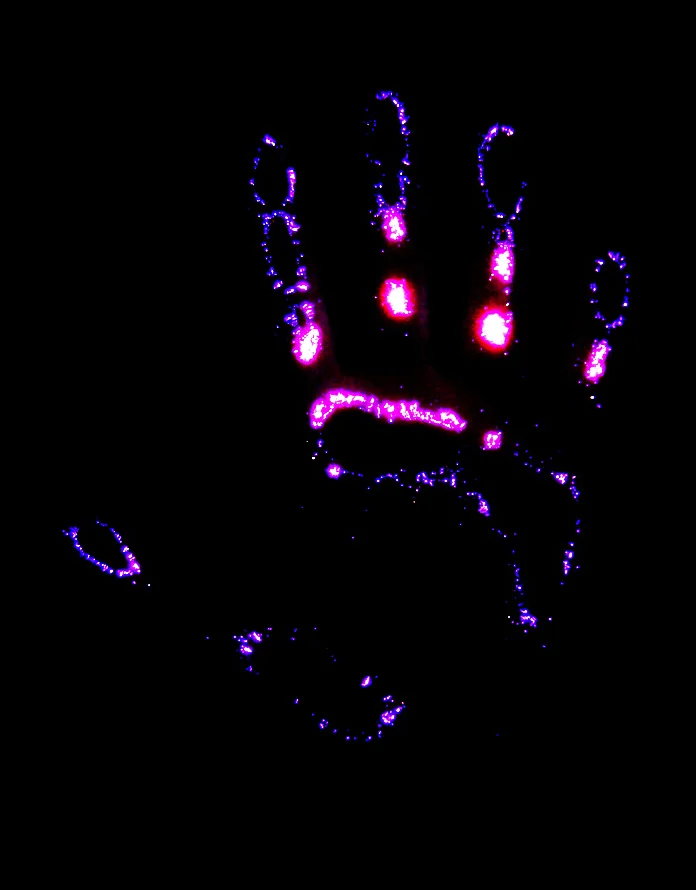
Semyon and Valentina Kirlian · Kirlian photography · 1939In 1939, Semyon Kirlian, an electrical engineer in Krasnodar, and his wife Valentina noticed a glow, like that of a neon tube, when the electrodes of a high-frequency medical generator came near a patient’s skin. They went on to photograph it: an object laid on film over a high-voltage plate leaves its silhouette surrounded by light. The light is a corona discharge, the air ionised at the object’s edges.
The Kirlians believed the glow showed a life force, an aura. Later studies traced its variations to moisture, pressure, voltage and grounding, and the claims about an aura have not been replicated. The pictures kept their pull anyway: Kirlian photographs appear on the sleeves of George Harrison’s Living in the Material World (1973), King Crimson’s USA (1975) and David Bowie’s Earthling (1997), which uses photographs Bowie took himself in 1975.
Kirlian takes the name, not the claim. A song’s character cannot be photographed directly either; the project tries to give it a visible trace.
Credits- Kirlian photography and Semyon Kirlian on Wikipedia
- Photograph: Hand in a Kirlian photograph by C4r0, CC BY-SA 3.0, via Wikimedia Commons
02Layers that move with the music
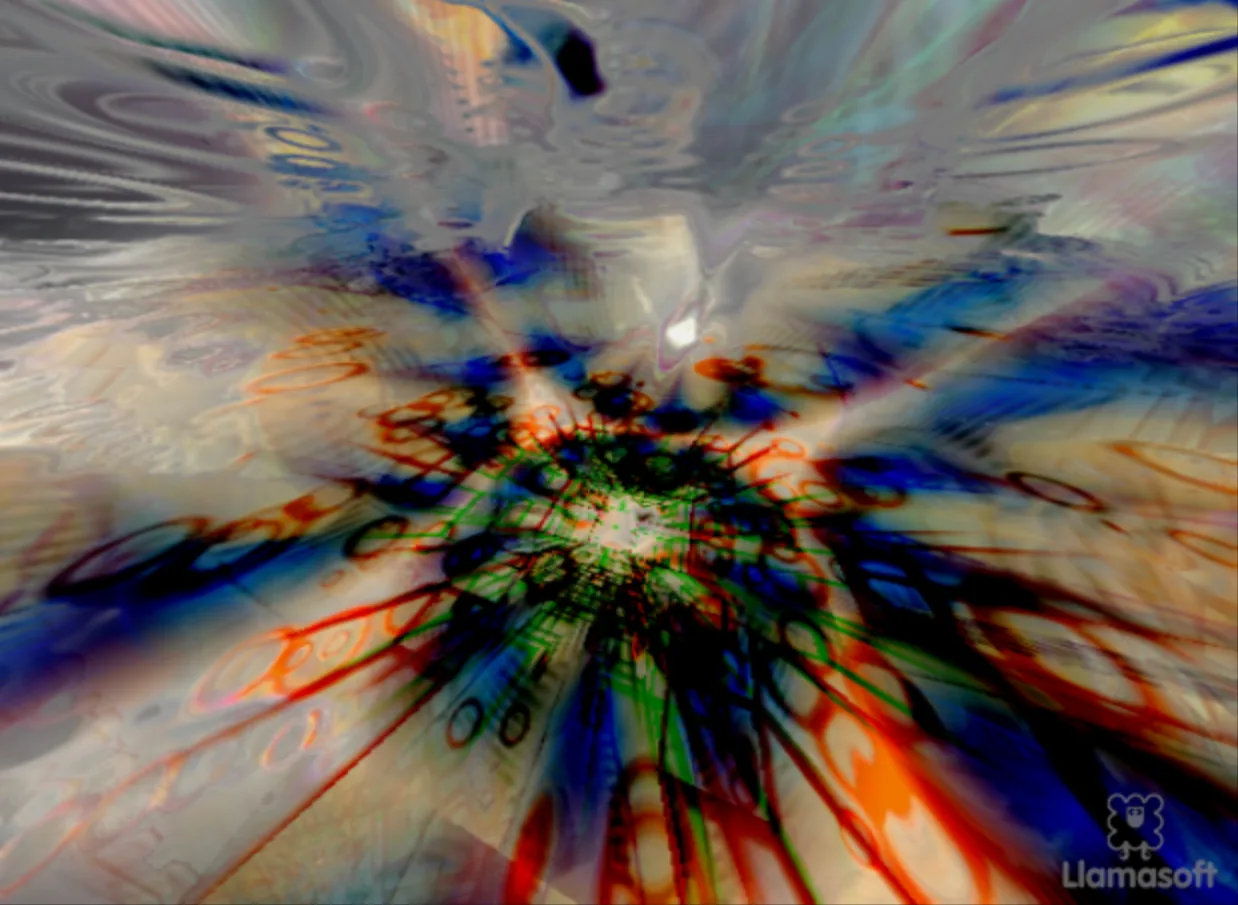
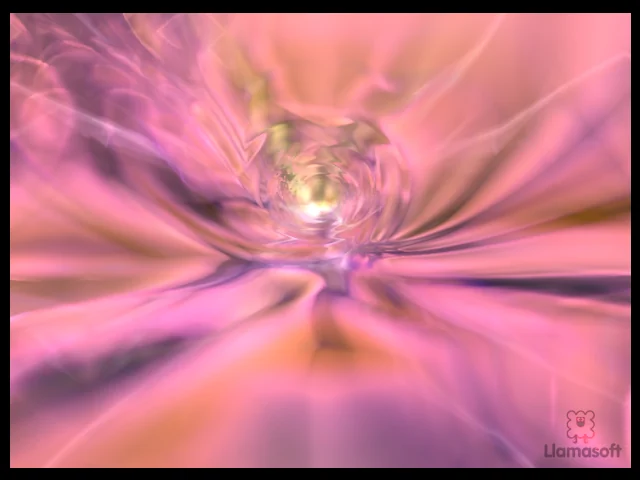
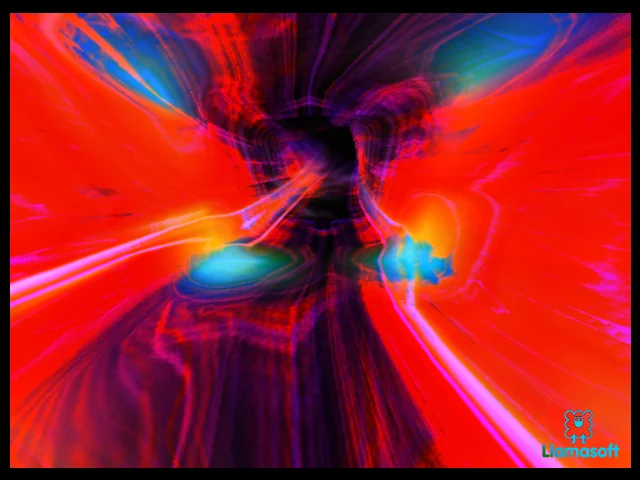
Llamasoft · Neon · Xbox 360, 2005Neon was the Xbox 360’s default music visualizer: whenever music played on the console, it started on its own, drawing several layers of light at once that moved with the sound. Up to four people could steer it with gamepads, or it could run by itself. It remains Kirlian’s primary reference.
Llamasoft described Neon as capable of generating “anything from soothing ambient swirls to strobing multicolour explosions”, endlessly configurable thanks to its modular nature. Kirlian’s premise starts here: that an image can become part of listening.
Credits- Neon by Jeff Minter and Ivan Zorzin, Llamasoft
- Neon’s page and official screenshots, the source of the two smaller frames
- Neon on Wikipedia
03A song has a shape
Martin Wattenberg · The Shape of Song · 2001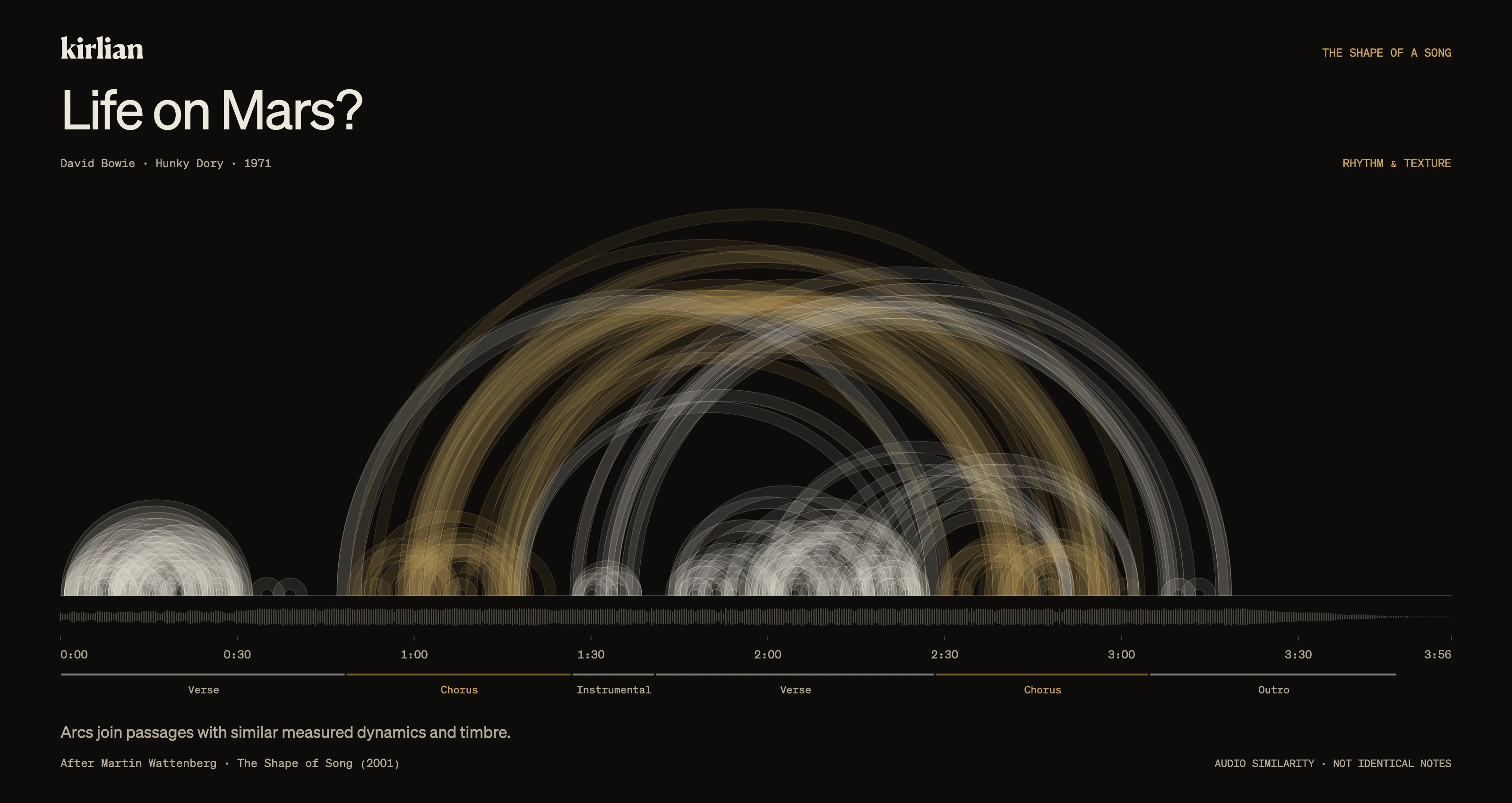
What does music look like? In 2001, Martin Wattenberg devised arc diagrams for songs so that their forms could be seen: every passage that repeats is joined to its repetition by a translucent arch.
His paper makes clear that the algorithm is not what matters most. He showed that drawing every repetition, as a dot plot does, produces noise, and that drawing only what is structurally essential produces insight. His slider for filtering by the length of a repeated passage is, quite literally, a “what matters” knob.
Wattenberg also suggests that future work might make such diagrams interactive, since static visualizations are less powerful than interactive ones. Reading the paper helped me think in simple terms: how could new technology carry those static, computationally accurate pictures of music’s complexity forward, and give them modularity, flexibility and specificity?
Credits- The Shape of Song, Martin Wattenberg, 2001
- Arc Diagrams: Visualizing Structure in Strings, Martin Wattenberg, IEEE InfoVis 2002
- More of Wattenberg’s art
- The drawing above: David Bowie’s Life on Mars?, made with Kirlian’s analysis
s0.initCam()
src(s0).saturate(2).contrast(1.3).layer(src(o0).mask(shape(4,2).scale(0.5,0.7).scrollX(0.25)).scrollX(0.001)).modulate(o0,0.001).out(o0)
04Visuals as code
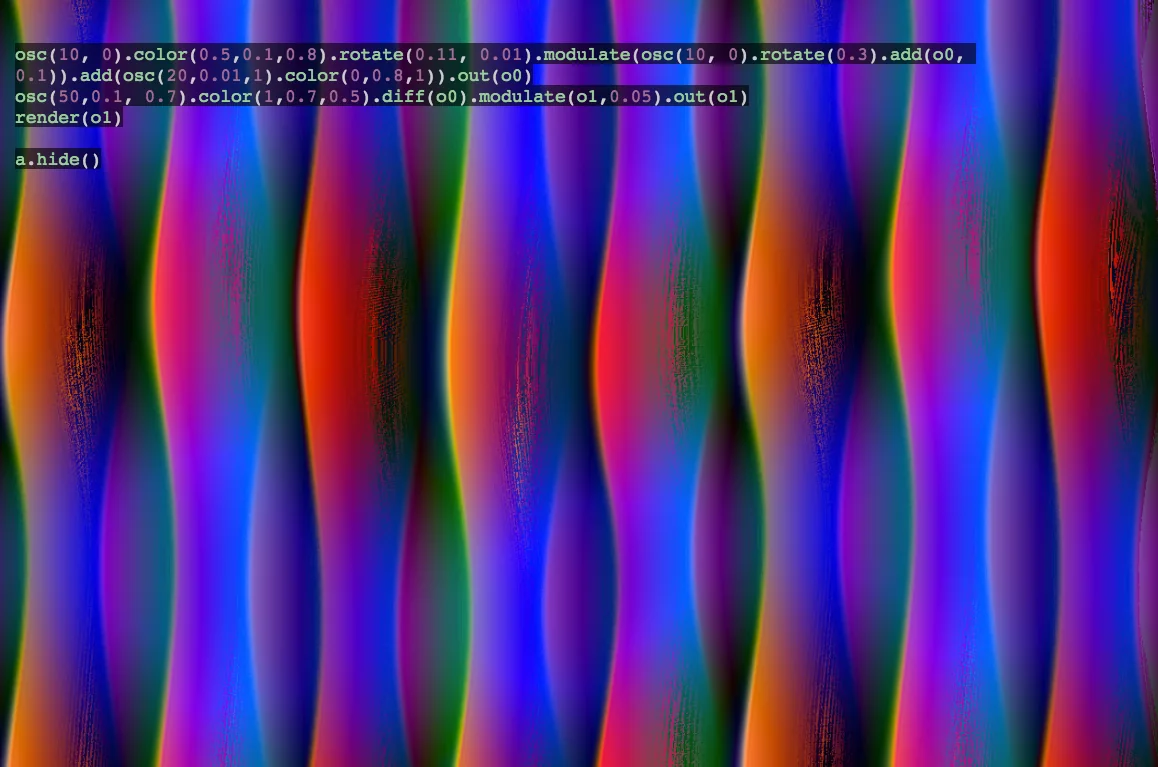
Olivia Jack · HydraOlivia Jack’s Hydra is a live-codeable video synth that runs in the browser, its syntax borrowed from analog modular synthesis: sources are patched through chains of transformations. Kirlian’s renderer can run Hydra programs as one of its layers.
Credits- Hydra by Olivia Jack; the image above is Hydra’s own
- Sketch: Glitchy Slit Scan by Flor de Fuego
05Presets anyone could write
Nullsoft · Advanced Visualization Studio · Winamp, 2000Advanced Visualization Studio, designed by Winamp’s creator Justin Frankel, shipped with Winamp from 2000. Unlike most visualizers, it let listeners build their own. A preset is a list of components, each one drawing or transforming the image and passing it to the next; some run code the author writes, such as the SuperScope, which draws lines and shapes from the waveform, and whole effect lists can nest inside a preset.
Steven Wittens, whose presets shipped with Winamp, describes how AVS updated a preset in real time, even between keystrokes, which drew coders and non-coders alike into forums on Winamp.com and DeviantArt to trade presets of ever-increasing complexity. Nullsoft released its source under a BSD-style licence in 2005.
A Kirlian visual is built the same way at heart: a stack of layers, some of them written as code, composed into one image.
Credits- Advanced Visualization Studio on Wikipedia, by Justin Frankel for Nullsoft
- Steven Wittens on AVS, with his preset packs
- Advanced Visualization Studio in action, uploaded to YouTube by marie t; the presets’ authors are not named


06A robot’s heartbeat
AIR · Moon Safari, live at the Royal Albert Hall · 2024When AIR played Moon Safari live, the visuals became such a huge part of the show. Electronic Performers is one of the most amazing songs to me, and its visuals made me think of a robot’s heartbeat. I started to wonder what it would be like if the robots themselves sang Electronic Performers.
With Kirlian, I can start to make that possible.
Credits- Music by AIR: Nicolas Godin and Jean-Benoît Dunckel
- AIR play Moon Safari, Royal Albert Hall, filmed 31 May 2024 for ARTE Concert with La Blogothèque, directed by David Ctiborsky
- Visuals created by Tiffany Chen, Antoine Jorel and Pierre Claude; visual creative direction, set and lighting design by Pierre Claude and Antoine Jorel
- Electronic Performers is from 10 000 Hz Legend (2001), played after the album on this tour
07One film for a whole album
San Charoenchai · visualizers for Beach House’s 7 (2018)San Charoenchai made a visualizer for every track of Beach House’s album 7: flat-shaded geometry carrying black-and-white patterns, inspired by the work of Bridget Riley, each one flowing into the next to make a single continuous film of 47 minutes.
Credits08A system, then tending it
Brian Eno · 77 Million Paintings, 2006 · Reflection, 2017Eno’s software layers his paintings and fades them on independent timescales. The artist designs the space of possibilities, not any single output. His system is song-agnostic; Kirlian’s premise is that the song itself is the seed.
For Reflection he describes choosing materials, letting an algorithm pattern them, then weeks of listening and tending: “You plant the seeds and then you keep tending to them until you get a garden you like.” That third stage is the gap Kirlian does not yet fill, and where the idea of a living artifact comes from: a visual that changes with the context a listener brings back to a song.
Credits- Brian Eno
- 77 Million Paintings, 2006
- Reflection, with Peter Chilvers, Warp, 2017
09Sound that draws itself
Jerobeam Fenderson and Hansi Raber · Oscilloscope Music · 2016In X-Y mode, an oscilloscope’s beam is steered by two signals at once. Feed it the left and right channels of a stereo recording and the music draws its own picture: two sine waves a quarter-cycle apart trace a circle, and harmonically related frequencies trace Lissajous figures. Jerobeam Fenderson and Hansi Raber compose the other way round, writing sound so that it draws the image they want. What you see is what you hear.
Credits- Oscilloscope Music, audiovisual album by Jerobeam Fenderson, 2016, with software by Hansi Raber
- Planets, on the Oscilloscope Music channel
- Oscilloscope music on Wikipedia
10Light played by key
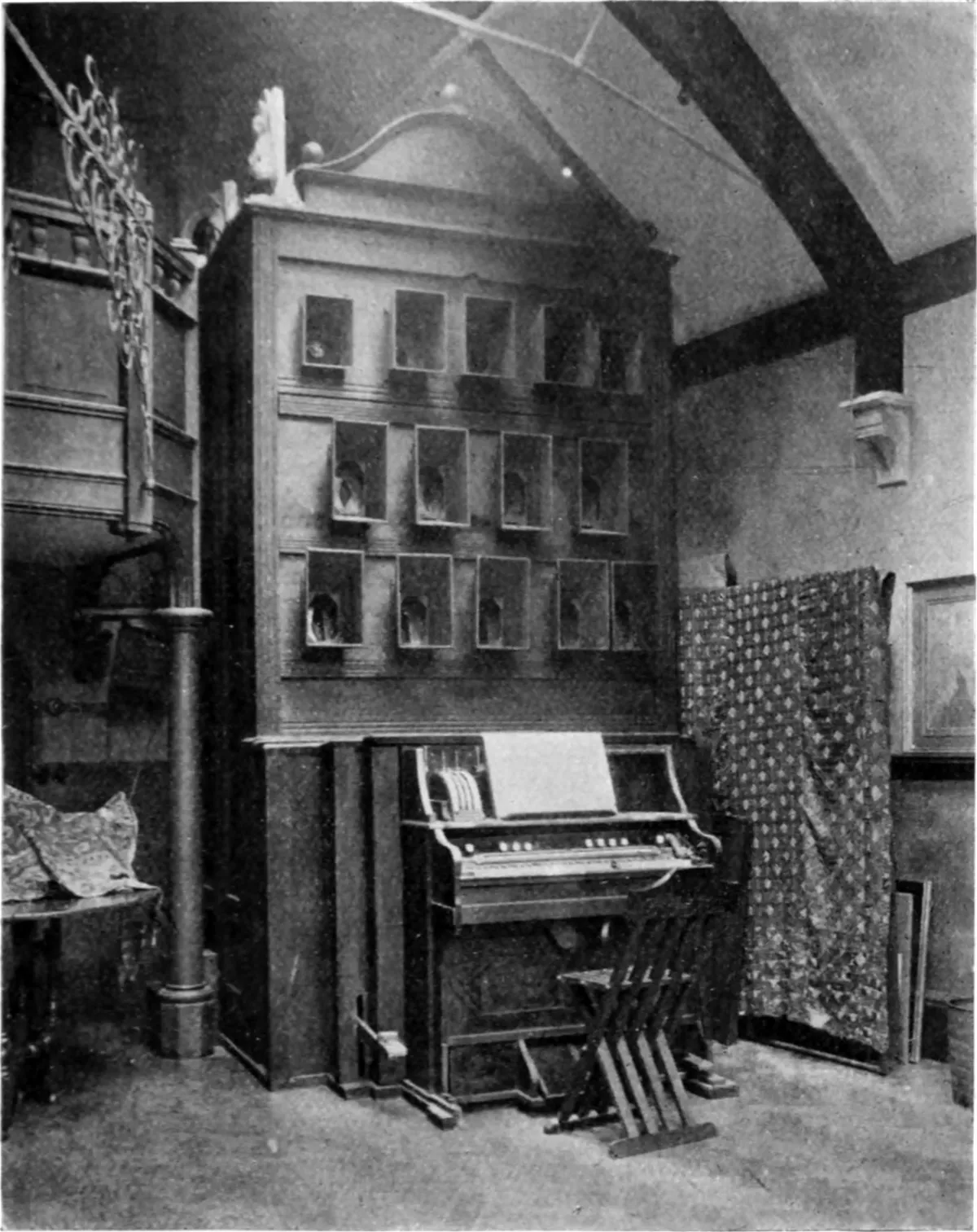
Castel · Rimington · Wilfred · colour organs, 1725–1930sColour music is older than the light bulb. In 1725 Louis-Bertrand Castel conceived an ocular harpsichord, in which each key revealed a coloured pane. In 1895 Alexander Wallace Rimington played his colour organ in public at St James’s Hall, London, casting colour onto a screen from a keyboard. In 1919 Thomas Wilfred built his Clavilux, “light played by key”, to perform shapes of moving light, an art he called lumia.
Castel’s and Rimington’s instruments tied each key to a colour. Kirlian keeps the ambition and drops the fixed mapping: what appears depends on what a passage does in a particular song.
Credits- Colour organs and Thomas Wilfred on Wikipedia
- Photograph: A. Wallace Rimington, Colour-Music: The Art of Mobile Colour, 1911, public domain, via Wikimedia Commons
- Lumia: Thomas Wilfred and the Art of Light, Smithsonian American Art Museum


11Forces tuned to frequencies
Robert Hodgin · Magnetosphere · iTunes visualizerRobert Hodgin built Magnetosphere in Processing as a physics system in which some particles attract and others repel. To make it listen, he split incoming audio into frequency bands and gave each particle one band to follow, so the music changed each particle’s charge and the forces between them. Apple asked The Barbarian Group to turn it into the iTunes visualizer; Andrew Bell ported it to C++ to run at interactive frame rates.
Kirlian’s analysis also listens to parts of the sound separately: it splits a recording into stems before measuring it.
Credits- Magnetosphere, Robert Hodgin’s project page and the source of the image
- Ported to iTunes with Andrew Bell at The Barbarian Group
12Dressing up the player
Jordan Eldredge · Winamp Skin MuseumThe creativity to dress up the interface for Winamp made me realize how important it is to reflect our own personality upon the music and media we play.
Credits- Winamp Skin Museum by Jordan Eldredge
- The skins come from the Internet Archive’s Winamp skin collection, each made by its own author
MoodboardThe original board
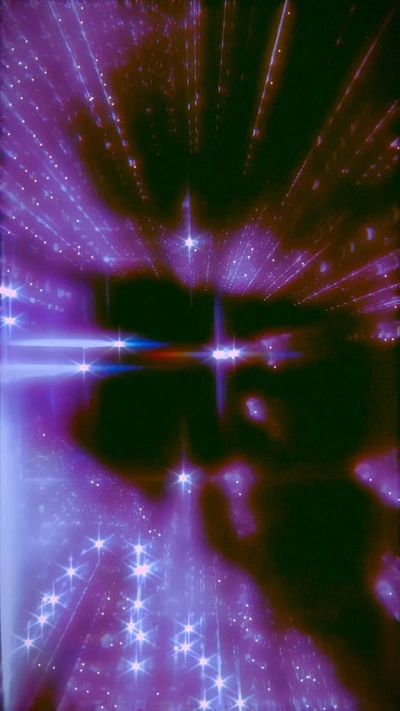
Kirlian · a Cosmos board by @lubizart · 38 elementsThe original moodboard for Kirlian, collected on Cosmos.

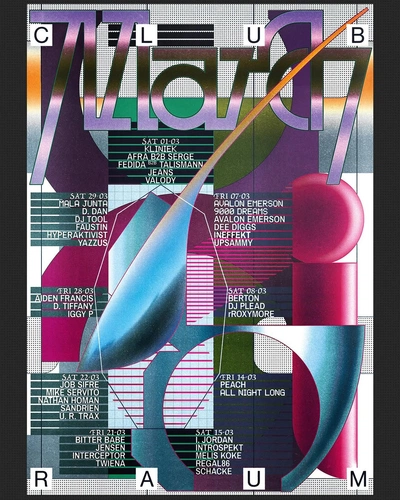
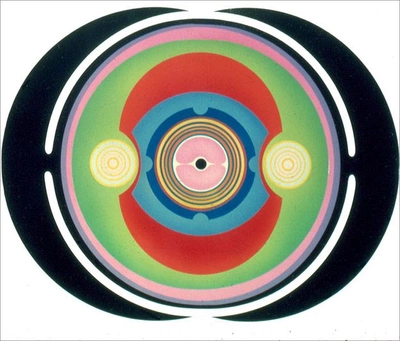
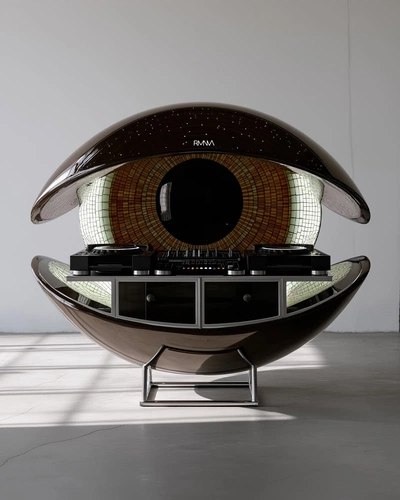

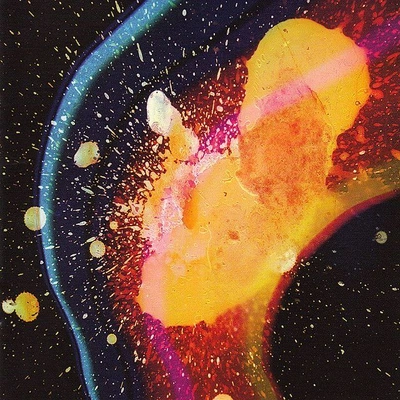

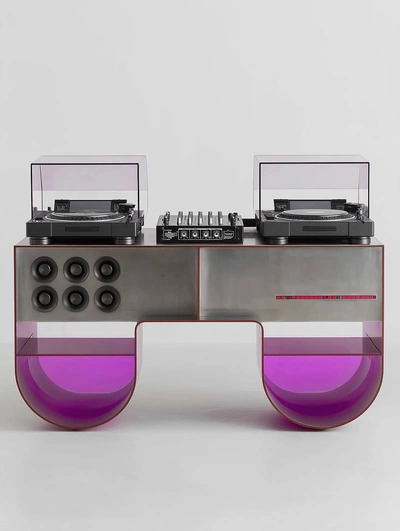
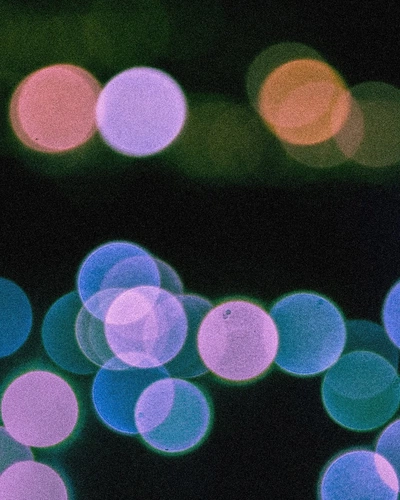
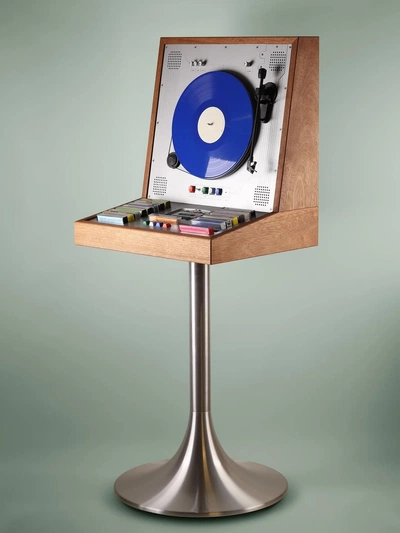
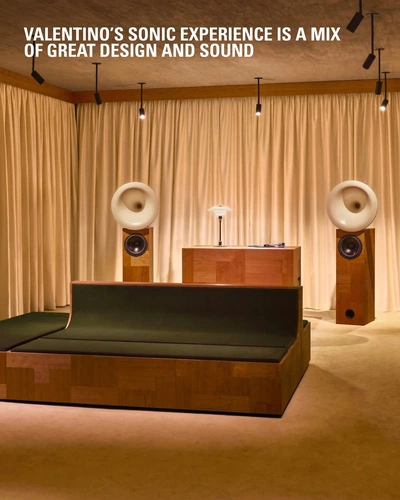 Open the full board on Cosmos ↗
Images in this preview were uploaded to Cosmos by Lebannon Rose, Manoloide, Alexandra De Vries Suárez, Sant, Mariano Arrigo, Lion Sauterleute, Romanovna Studio, Matt (Nature Photography), Courtney Jean, TAAD, Adrien Lahaye, Love Hulten, Highsnobiety Design, and others; Cosmos credits uploaders, who are not always the makers. Every element is credited on the board.
13What Kirlian takes from them
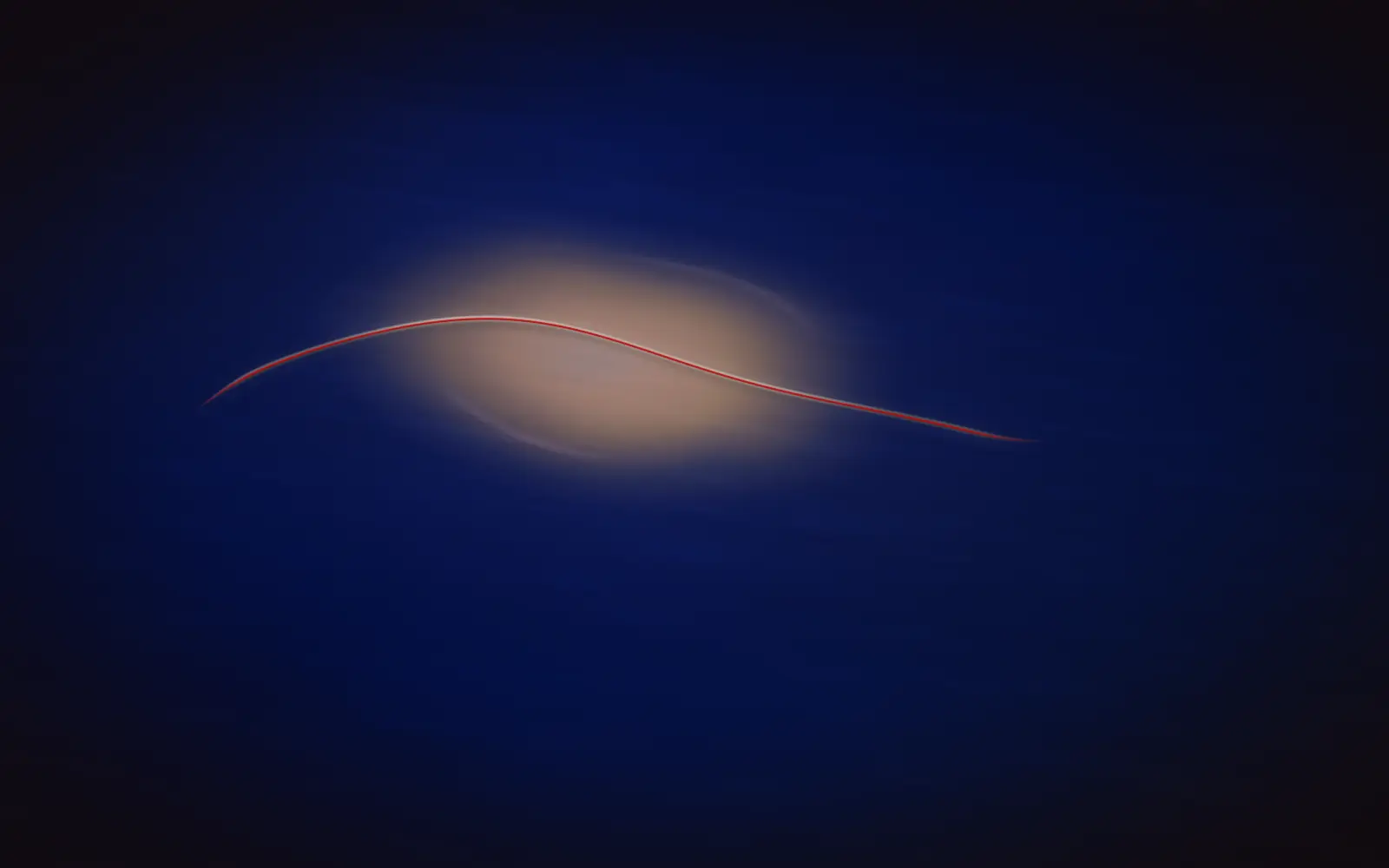
Kirlian · Chopin, Berceuse in D-flat major, Op. 57 · 4:04From Kirlian photography, the name: something unseen leaving a visible trace. From Neon, layering and modularity: several images at once, each moving with the music, built from interchangeable parts. From Wattenberg, the shape of a song, and the discipline of showing only what matters. From Hydra and AVS, visuals written as code, in parts that can be combined. From AIR, image and sound performed as one work. From San Charoenchai, one visual language carried through a whole album. From Eno, designing a space of possibilities rather than a single output. From oscilloscope music, colour organs and Magnetosphere, three ways of tying an image to sound: the signal itself, the keyboard, and separate frequencies. From the Winamp skins, the listener’s own mark on what they play.
Kirlian brings these together in two stages. A model reads an analysis of the recording, its context and any notes from the listener, and writes a brief: a visual world and how it should relate to the music. A second stage turns that brief into code, built from layers, shaders and Hydra programs, which the browser runs alongside the recording.
How the system works is in What is Kirlian?